Bringing critical and analytical insights from the history of political philosophy—especially late modern and contemporary thought—and from normative political theory, my research engages topics in conflict and peace studies, the intersection of politics and religion, and East Asian politics. My earlier work explored the critical insights Hannah Arendt’s thought offers for understanding global peacebuilding. In my current research, I am broadening the range of theorists I engage by turning to Arendt’s contemporaries—specifically legal scholar Carl Schmitt, postcolonial theorist Frantz Fanon, and public theologian Dietrich Bonhoeffer.
Research 1: Peace and Peacebuilding
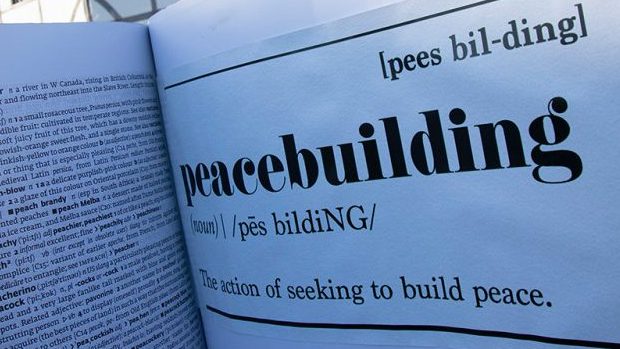
My book manuscript, Arendtian Peace: Transforming Conflict through Worldly Politics, analyzes the critical implications of Arendt’s thinking for contemporary discourse on conflict and peace. Paying attention to institutional models that she engages with––i.e., nation-state, ancient polis, and modern republic––I show that for Arendt, “worldliness” is a crucial attitudinal quality for citizens dealing with the demands of change and continuity in free politics. I then demonstrate that such a dual aspect of Arendt’s ideas provides original insights into major issues of peace, including idealism vs. realism, the local vs. the global, international federation, postcolonial resistance, forgiveness and reconciliation, and conflict/peace processes. By analyzing which forms of political association create the most appropriate conditions for active political participation, civic engagement, and effective peacebuilding, Arendtian Peace provides theoretical rigor for community-building and offers normative insights into the basic conditions for sustainable peace.
Preliminary findings from this book have been published in leading political theory journals. “Building Communities of Peace: Arendtian Realism and Peacebuilding,” which appeared in Polity, highlights Arendt’s special sense of realism that fosters ambivalent yet dynamic accounts of peace and argues that her thinking offers a balanced insight into peacebuilding beyond liberal and critical approaches to peace. “The Real Promise of Federalism: A Case Study of Arendt’s International Thought,” published in the European Journal of Political Theory, critically examines the competing discourses of anti-imperialism and anti-authoritarianism via Arendt’s council-based federalism. “The Lex of the Earth? Arendt’s Critique of Roman Law,” published in the Journal of International Political Theory, analyzes Arendt’s appropriation of ancient legal sources and its implications for the debate on democratic agency and international relations.
Research 2: Politics and Religion
My next book project, provisionally titled Friends and Enemies under God, engages with contested issues in political theology by comparing the ideas of legal theorist Schmitt, anti-Nazi theologian Bonhoeffer, and political theorist Arendt. Inspired by Arendt’s discussion of three ways of dealing with otherness––namely, being-against-others, being-for-others, and being-with-others––the study considers Schmitt’s ambiguous reliance on theology in constructing a limited or political form of enmity, Bonhoeffer’s reformulation of the ideas of divine grace and the human will to engage in neighborly love and forgiveness, and Arendt’s “pagan” value of worldliness. Through the analysis, this project aims to articulate a sensible form of political subjectivity informed by the dangers and benefits that religion brings to democracy and peacebuilding. Part of this research appeared in the Journal of Religious Ethics, in which I analyzed Arendt’s and Bonhoeffer’s thoughts on forgiveness. I have also developed a paper from this project that highlights religion’s dual role in an era of misinformation, investigating a way for religion to be a conscientious voice in politics yet eschew becoming a tyrannical force itself. This work has been published in The Review of Politics.

Research 3: East Asian Politics
I have also been developing three articles on the implications of Arendt’s thought for East Asian politics. One project analyzes the contrasting perspectives of Arendt and Schmitt on Mao and his nationalism, which I plan to expand into a broader analysis of politics, resistance, freedom, and decolonization. Another paper explores the reception of Arendt’s thought in Japan and Korea and its implications for postwar reconciliation and regional relations. A third project traces the historical development of Arendt’s influence among Korean scholars and practitioners, with particular attention to the shifting image of Korea in global politics. Based on these projects—and in collaboration with Arendt scholars interested in Asian politics—I plan to prepare an edited volume provisionally titled Arendt in Asia.

My scholarship reveals the complex relationship between conflict and peace as well as this complexity’s significance in international peacebuilding. Specifically, it contributes to contemporary conversations in political theory, international relations, and conflict/peace studies by illuminating the relationship between violence and politics, ways of peace engagement, state/democratic agency, the scope of citizenship, and religion’s role in peacebuilding. In this way, my research advances knowledge of how we achieve concrete freedom and human excellence by forming political communities with the humanistic vision of peaceful coexistence with others.
 Shinkyu Lee